154_h_button.gif
 
152_archive_button.gif


Healthy Connections
Innovative connectors help make today’s
technology-enhanced medical breakthroughs possible.
By John C. Colwell, Bishop & Associates Inc.

One of the most interesting aspects of the connector industry is the degree to which connector manufacturers are able to optimize their product designs to meet the unique needs of the industries they serve. This is most evident in the medical electronics industry, which poses a rich mix of unique application, environmental, ergonomic, aesthetic, and reliability challenges.

Among the more significant issues confronting the health care industry, is continually rising operational costs and the increasing shortfall of professional medical personnel. For example, by 2015, the projected shortfall in North America exceeds 300,000 personnel. Thus, medical devices that conserve time, eliminate mistakes, or otherwise increase human productivity are in very high demand. The American Association of Medical Instrumentation (AAMI) is currently developing a new human factors standard, AAMI HE75:200X, which is scheduled for completion next year. The standard addresses human factor guidelines for the design of safe, effective, and user-friendly medical devices. Connectors are among the included topics.

While these special challenges apply across the board, they are most critical in patient monitoring. Patient monitors include ECG monitors, respiratory monitors, blood pressure monitors, and oxymeters. Monitors are deployed throughout the clinical environment; at the bedside, in operating rooms, ICU/CCU environments, catheter labs, and maternity wards. As patients move through the system, they are constantly being re-connected to the monitoring systems, a time-consuming and error-prone process.

Upgrading the patient cable interconnect from a MIL-C-5015-based connector to a push-pull plastic circular connector largely solved this problem. The newer push-pull connectors not only provide color coding and keying to prevent the possibility of cross-connection, they also provide positive audible and tactile feedback, which gives immediate confirmation of a proper mate. This family of connectors was so well received by the medical community that it is now enjoying expanded use in surgical drills and saws, electrosurgical instruments, laparoscopic instruments, and mission-critical heart-lung pump applications. New inserts capable of carrying CO2 gas or saline solution were developed for laparoscopic applications with electrical, fiber optic, and fluidic contacts.


Many of these applications require sterilization prior to each use. While the connectorized cable assembly can generally withstand the ethylene oxide (EtO) and gamma sterilization processes, the economics of sterilization and maintaining a state of sterilization are changing, making disposable products increasingly attractive. Once again, the connector industry responded with a line of economical, limited-use, and disposable connectors designed for insert-molded, patient monitoring cable interconnect applications. Illustrated (above, left) is the disposable L.U.C.-Limited Use Connector system from Fischer Connectors. The pump application (above, right) uses the ODU Medi-Snap connector. Other manufacturers of connectors in this application space include Amphenol, Binder, Lemo, MEDCONX, Tyco Electronics, and others.

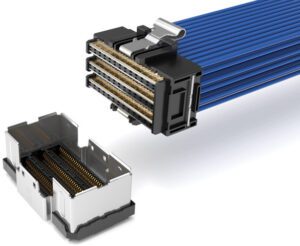
Diagnostic patient cable applications, such as ECG and EEG, where the cable connection to the equipment console is of a more permanent nature, typically employ bayonet-coupled plastic circular types or rectangular thumb-screw types. Illustrated below left is the Tyco Electronics CPC Series circular connector family. At the right is the 3M MDR Series rectangular ribbon connector.


Another major challenge to the medical industry—and to medical equipment designers—is the need to develop more powerful imaging capabilities in order to increase both early diagnosis and diagnostic accuracy. To this end, diagnostic ultrasound imaging is evolving from two dimensional (2D) imaging to three- and four-dimensional imaging. A typical 4-D transducer cable can support 240 or more channels, thereby posing a significant I/O connector density challenge. At the same time, imaging equipment is getting smaller, sufficiently so that ultrasound imaging is now finding its way into EMS and battlefield use.

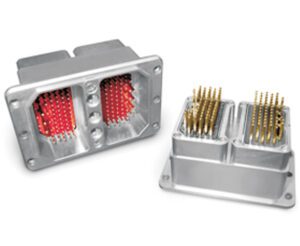
In response to this I/O density challenge, ITT Cannon developed its DLP connector system, illustrated at the right. The DLP consists of a high-density, rectangular array of landed contacts set within the transducer cable connector shell, and a corresponding array of ZIF contacts on the equipment console side. The connector also features a locking shutter mechanism, which protects the contacts when unmated. The connector addresses a multiplicity of needs, including contact density, signal integrity, shielding effectiveness, ease of use, ease of cleaning, reliability, and aesthetics.

It should also be noted that this new generation of ultrasound imaging equipment poses significant design challenges to the transducer cable design. The cable designer must not only meet all of the aforementioned requirements, but also size, flexibility, and durability requirements.


The illustration at the right shows a micro-miniature, multi-conductor cable threaded through the eye of a needle. This accurately depicts the degree of miniaturization occurring in ultrasonic imaging devices. The illustration at the far right depicts the real world environment in which these sophisticated cable assemblies must survive.

More importantly, the former is also a good indication of the future possibilities of ultrasound imaging, which includes ultrasound imaging catheters and ultrasound-guided surgical probes.

Among the many other developments in the diagnostic imaging area include the merging of Positron Emission Tomography (PET) with Computerized Tomography (CT) or, less commonly, Magnetic Resonance Imaging (MRI). PET utilizes image-enhancing pharmaceuticals to provide very accurate information on a molecular tissue level, while CT and MRI provide very accurate anatomical imaging. When processed together, the combined modalities result in a dramatic gain in diagnostic power. The signal processing demands also increase dramatically; necessitating the use of high-performance backplane interconnects. The cPCI connector was widely used in CT systems. New designs, particularly PET/CT and SPECT systems, employ standards-based, high-performance switch fabrics and embedded multi-core processors. Communications include 10 gigabit Ethernet XAUI, gigabit Ethernet, fiber channel, or IEEE 1394B.


In the MRI arena, new application areas are driving demand for systems with more powerful magnets. The typical field strength of an MRI machine is 1.5 Tesla (1.5T). Neurological studies, an area of high growth, are creating demand for more powerful 3T machines. Research machines are operating at 7T and 10T. As a result, more cooling and more powerful RF power suppliers and gradient amplifiers are required. The connector industry continues to respond to the needs of this equipment segment by providing non-magnetic connectors for a broad spectrum of applications. As magnetic flux densities move up to 3T and beyond, completely non-magnetic connectors will become commonplace.

Connector manufacturers have also made excellent use of standard, modular inserts to elegantly address not only the complex interconnection needs of the MRI patient coil application, but also the important aesthetic needs. This is particularly important because MRI gradient coils produce discomforting, loud noises that make the MRI sound like a tire shredder. Good aesthetic design prevents an MRI from looking like one.


Illustrated above is an RF patient coil cable assembly based on the ODU MAC Series. Shown below is the Hypertronics ClearImage non-magnetic connector system. Mixed signal applications are common in MRI systems and include power contacts to 60 amps, signal, and RF up to 6 GHz.


Inside the MRI gantry is a complexity of magnets, coils, thermal sensors, heaters, and cooling apparatus. Much of the MRI electronics are located in an equipment room adjacent to the shielded MRI chamber. Equipment includes AC power regulation, RF power supplies, gradient amplifiers, and a cryogenic cooling unit.

Standard RF and power connectors are commonly found.


Most of the more unique connector solutions reside “outside the box.” However, another area of interest is in vivo medical devices, which reside “inside the body.” Implantable devices comprise a growing area of connector application. Cardio rhythm management products represent the more mature segment of the market, while drug dispensing devices, cochlear implants, and neural and bone growth stimulators represent rapidly developing segments. Here again, the connector industry developed optimal solutions to these application requirements, including high-reliability micro-miniature flex circuit connectors and pluggable electrode wire interconnects.


Illustrated above is a spring contact by Bal Seal Engineering. A single spring and stacked spring designs are available, depending on the application need. Illustrated below is the Hypertronics ImplanTac biocompatible contact based on Hypertac hyperboloid contact technology. Both designs rely on multiple points of contact for reliability.


Looking to the future, nanotechnology-based implantable devices, particularly biological sensors, represent an area of exciting long-term development opportunity. The connector requirements for these evolving devices are not yet clear. However, what is clear is that the connector industry will rise to the new challenges.


John Colwell
Director, Telecom, Medical and Instrumentation, Bishop & Associates Inc.

John Colwell’s background includes 10 years at Nortel Networks‑Cable Group, where he directed the U.S. premises cable marketing effort. In addition, Colwell directed Nortel's global product development group. Prior to joining Nortel, Colwell held positions in engineering, business planning and development at Amphenol Corporation.


  home_top_buttons.gif
  con_sub_med_.gif

Bishop & Associates, Inc. © 2010