Bookmark and Share

Specifying Circular Connectors for Industrial
Automation and Communication Applications
By Fred Kozlof, Tech Support, CONEC

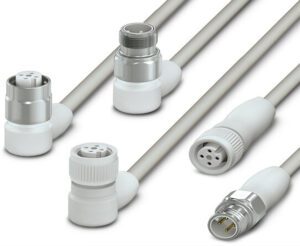
Circular connectors are used in many automation technology applications, such as sensor signal transmission and low power supply, or for data communication in field bus technology. Metric-sized circular connectors, like the M12 and M8, have been around for many years, but product evolution and technology advancement has provided performance enhancements and broadened their applications. The M12 connector, for example, is a standard product that is available from a number of suppliers. It’s a compact yet very rugged IP67 connector designed for harsh environments that provides a small footprint, pin counts in the range of 3 through 12, gold-plated contacts for low-level signal integrity and high reliability. Although this is a standard connector that has been commoditized, for the most part, there are still some features and new configurations available from different suppliers that should be considered when specifying such connectors for a particular equipment design.

Field-Attachable Versions

Field-attachable connectors allow for stripped wire to be attached to the connector in the field using a simple screwdriver tool. This facilitates a faster, less complicated installation. For example, some cables may be challenging to install, due to the need to be fed through holes as small as 6mm. Circular connectors that can be terminated in the field solve this problem, compared to buying double-ended, overmolded cable assemblies that require holes or spaces of 20mm or more. Also, if the exact cable length is unknown, the cable length may be sized on the job, which avoids order errors. For example, the M12 available in a field-attachable version, is a clear benefit for an installer who has to feed wire through various pieces of equipment and barrier openings, which would be nearly impossible with an overmolded cordset that already has a connector terminated on it.

Field-attachable connectors are available in axial construction as well as a 90-degree angled construction. This also provides a lower profile/clearance advantage for tight space installations. Finally, make sure the field attachable that you specify maintains the IP67 (or greater) integrity of the whole system.


Overmolding

Overmolded metric type connectors can improve the durability and streamline the size, as well as the appearance of a cable connection. Overmolding can also reduce the cost of lifetime ownership of cable assemblies, making it an important consideration for harsh environment applications. An extra strain relief around the wire terminations offers increased durability that results from the overmold material bonding to the cable jacket. The overall assembly thus gives a high-reliability connector on each end, with customer specified cable properties in between.

In addition to overmolding, the cable jackets need to be specified. Some performance parameters to consider include UV and sunlight resistance, low temperature flex rating for indoor-outdoor applications, burial, chemical/oil-resistance, weld slag, and high-flex needs with millions of cycles possible. Overmolded connectors are available in right angle and straight, shielded and unshielded versions. LEDs embedded in the overmold material provide an easy indicator of signal integrity or power, as an option.

Additionally, overmolding makes some customization possible, such as private labeling with company logos, custom lengths, and colors.


High-Temperature

The demands for higher temperature resistance continue to increase in industrial automation, so this may be one of the most important considerations for an equipment designer and installer. For these kinds of applications, some suppliers offer high-temperature connectors, some which can withstand 8,000 hours at a constant temperature of +125°C, with temporary peak values of up to 150°C over 2,000 hours. Such connectors are a particularly good fit for food and beverage industry applications, as long as they also meet the requirements and industry standards for chemical and temperature resistance.

Today, circular connectors can be made of materials that meet those high hygienic needs and extended times at extreme temperatures. Be sure to recognize in your specs the need to tolerate harsh cleaning agents, in addition to high-pressure cleaning processes. If you need to withstand high-pressure wash downs, you must specify protection class IP69 K.


Industrial Data Bus Protocols

The utilization of field bus technology in the industrial sector has increased rapidly over the last few years, and if paired with a cable assembly that utilizes a circular connector, the protocol types needed are important to define at the design stage. Data bus systems like Profibus, DeviceNet, and Industrial Ethernet each have their own defined type of connector, and in some cases, color coding, contact arrangement, and wiring code. The construction and design of the connectors that are necessary for data communication are bus-specific and should be carefully selected. Circular versions are available for Profibus DP, industrial Ethernet, and DeviceNet protocols in several specifications from a number of manufacturers.


Growing Popularity of RJ45 and USB Results in New Products

While metric type connectors have become the standard in industrial applications, RJ45 and USB circular connectors are expected to become more popular. Market demand has resulted in new families of RJ45 for Ethernet, and USB interfaces in ruggedized forms, and offer an IP67 rating, or better.

In the industrial automation market, much of the upload and download activity that goes on in programming machines is done via Ethernet and/or laptop computer. Such connections can be plugged into a sealed RJ45 connected point-to-point allowing for easy download of data without requiring machine shutdown. The ruggedized circular body of the RJ45’s housing is ideal for this, because it protects against exposure to any kind of abuse or ingress from dust, dirt, or water. Housing materials can be plastic, metalized plastic, or diecast zinc.

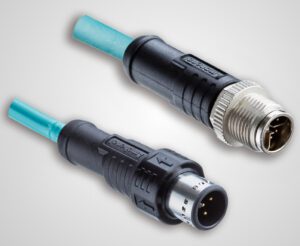
For structured, industrial cabling in accordance with Realtime EtherNet/IP specifications, RJ45 connectors with bayonet coupling mechanism are now available that conform to IEC 61076-3-106 standards (photo, right, courtesy of CONEC). The receptacle housing kits are available in front- or rear-panel-mount with different termination technologies. Inside the device, connections can be made with inline couplers, IDC, or solder termination options with appropriate strain relief to tolerate machine vibrations. This recent product development provides for reliable connections for heavy industrial environments. The mating cable applications can be specified for either indoor or outdoor use.

The same protection is true of the ruggedized circular USB housing. USB connector systems for harsh environments can be used for front or rear mounting into a panel with a thickness up to 3.2mm. The integrated USB connector meets USB 2.0 specifications, and provides IP67 sealing performance when the connector halves are fully mated or the protection cap is applied. The new addition of USB ruggedized connections now adds to the data and peripheral possibilities in applications for harsh environments, such as ”thumb-stick” loaded applications and data storage.

Using RJ45s and USBs in these types of industrial applications are examples of the connector industry pushing standard I/Os to the edge in terms of where they’re used. Previously only used in office-type, clean environments, today’s I/O connections are being tested by a growing need for instant online access by all kinds of machinery. Many designers want to access their complex electronic and control systems via the Internet. These new ruggedized circular connectors enable that ability. Factory floor devices can now be equipped with these types of connectors. The need to troubleshoot from a remote location is driving this trend. Remote access is the key, and the Ethernet interface provides that.


When can I get them and what will they cost?

Last, but definitely not least, pricing and availability are the most significant considerations in specifying connectors for industrial applications. While traditional circular connectors based on MIL-originated specifications and sizes were considered too costly and hard to get, the current metric circular connectors, RJ45, and USB can be chosen and delivered in the shortest time period, and at very reasonable prices, especially considering their robustness in a harsh industrial environment. If a connector is needed for an installation on a factory floor, short lead time is critical. Even with the latest features and advancements, in the end, a design engineer wants to work with the supplier that won’t delay his installation.

In summary, there are many connector formats available for the signals, power, and data needs of industrial automation and communications. After careful evaluation of your specifications, size restrictions, ease of installation needs, and cost factors, give some serious consideration to the various families of metric and industrial Ethernet and USB ruggedized circular connectors.


Fred Kozlof has been in the connector industry for more than 30 years. He has been involved in design engineering, field application engineering, product marketing, tech support, and sales. Kozlof has been with several connector companies, working with a diverse range of connectors, such as crimp connectors, power connectors, card edge connectors, commercial and MIL EMI filter connectors, and industrial I/O connectors. Now with Conec Corp. in Garner, NC, Kozlof is heavily involved with several families of IP67 connectors for harsh environments.

For more information, contact CONEC
, 343 Technology Drive, Garner, NC, U.S., 27529; call +1 919 460 8800; fax +1 919 460 0141; email info@conec.com; or visit www.conec.com.

Bookmark and Share


Bishop & Associates, Inc. © 2011