154_h_button.gif
 
152_archive_button.gif


Making the Connection—Compliant Pin or Surface Mount?

By Bob Hult, Bishop & Associates Inc.

Interconnecting the many components that make up electronic systems has always been a challenge for design and manufacturing engineers. Insuring reliable, low-resistance connections using accepted manufacturing processes is a critical element of system reliability. Making changes to a fully understood and documented manufacturing process often meets serious opposition until the new process can demonstrate consistently reliable connections over years of service in a variety of environments.

The earliest electronic devices were often connected via discrete wires soldered to terminal strips, or directly to metalized pads on phenolic resin boards. These point-to-point wired connections were labor intensive, prone to human error, and difficult to service or repair. In order to access individual components for servicing, systems were partitioned into modules or PCBs with individual wires providing the interconnection.

The introduction of the PCB edge connector was a major step forward, as technicians could easily plug boards in and out without the need for soldering tools and skills. Rather than remove and replace an individual failed component, a fault could be traced down to the PCB level. The defective board could be replaced and the equipment quickly returned to service. The PCB became a field replaceable unit (FRU), which could be sent back to the factory for failure analysis and possibly repaired.

Components were mounted on the top of the PCB with their leads extending through holes drilled or punched in the board. The underside of the board had a pattern of etched copper traces, which, when soldered to the protruding component leads, provided electrical interconnection. As individual devices became miniaturized and packaged in ceramic or plastic dual-in-line packages, much greater system density was achieved, but the technology used to attach individual components to the board, both active and passive, remained through-hole soldering.


Dual in-line package (DIP) sockets, soldered to the board, allowed the replacement of individual integrated circuits in the field.

Demand for smaller packages, much higher pin counts, higher electrical performance, simplified PCB routing, and automated assembly were some of the pressures that inspired the development of surface-mount technology. Rather than drilling relatively large holes in the PCB, surface-mounted components are soldered to metallic pads located on the surface of the board. Tiny vertical via connections extend below these pads and make contact to one or more copper layers laminated within the board. Active devices can be mounted much closer together, minimizing signal delay and skew. Elimination of the through-hole allows the possibility of mounting components on both sides of the board, improving the efficient utilization of valuable PCB real estate. Fully automated “chip shooters” can populate a large board in minutes with hundreds of active and passive devices. These boards are then soldered using convection hot air or vapor in a single operation to simultaneously reflow thousands of connection points. Today, the vast majority of devices attached to a PCB utilize surface mount technology. One of the very few exceptions has been connectors.

For many years connectors have been attached to the PCB using through-hole technology. Contact tails protruding below the board were typically wave-soldered, producing a reliable mechanical, as well as electrical, attachment to the board. The resulting solder joint is easy to inspect, and repair is relatively simple. Years of successful application experience proved the reliability of this process. As other components adopted surface mount attachment, the need for wave soldering was reduced. The response was to develop surface mount compatible through-hole connectors. As solder paste was screened onto the surface of the PCB for the surface-mounted devices, paste is also inserted into the connector hole pattern. Connectors are applied to the board, pushing the connector tails through the soft paste. The board is then exposed to hot air or vapor, simultaneously reflowing the surface-mount as well as through-hole connectors. Since the connectors are exposed to much higher temperatures during the reflow process, the plastics were changed to liquid crystal polymers, or other advanced materials, which can withstand these higher temperatures. The finished solder joint looks similar to a wave-soldered part.

Through-hole soldering works fine on .062 thick, two- or three-layer daughtercards, populated with many devices, but a backplane is another animal. Contemporary backplanes typically have no active components on them, and are often populated with a large number of bulky backplane connectors. The complexity of interconnecting thousands of high-speed differential circuits on a backplane, supporting 20 to 30 daughtercards, has driven these boards to contain as many as 30-plus layers, and may be in excess of .300” thick. Large network backpanels can reach 20” X 36” and require the placement of many high pin-count backplane connectors. Trying to heat a backplane of this size and thickness to reflow temperatures is difficult and could damage the board. The solution was the introduction of compliant pin or press-fit technology.

Compliant pin termination utilizes a special section of the terminal that is designed to compress, as it is inserted into a plated through PCB hole. The compliant section of the connector tail establishes and maintains multiple gas-tight points of contact to the plated walls of the hole. They are capable of insuring low resistance joints through a nominal range of production hole diameter tolerances. Connectors equipped with compliant pin sections are simply stitched, or gang pressed, into the PCB holes without the use of heat.

Over the years, several competitive compliant designs have been developed, including the eye of the needle, bow tie, and action pin. Each has its adherents within the industry. In all cases, energy is stored in the compliant pin section and provides the forces necessary to insure a reliable connection without damaging the PTH.


Compliant pin technology eliminated thermal stress on the PCB, as well as the need to remove solder flux. Short circuits caused by solder bridging were eliminated, and replacement of individual contacts in the field, without the need for a soldering iron, was possible.

The transition from traditional through-hole solder to compliant pin was not without its skeptics. Asking board assembly shops to scrap many years of accumulated experience with proven soldering processes, to accept the reliability of a pressure connection, took 10 years to achieve. Questions about plated barrel deformation, breached plating, PCB layer delamination, as well as the ability to maintain a gas-tight connection after years of thermal cycling, required extensive testing of the new technology. The number of times a pin could be removed and replaced from the same hole was a major concern. Quality managers, accustomed to inspecting for cold solder joints, could find few visual clues about the quality of a compliant pin connection. Only after extensive testing and years of successful implementation has the compliant pin termination become the accepted termination process for connectors today.

Now, new forces are beginning to challenge the compliant pin termination. The drive for greater system density has resulted in connectors in 1mm and smaller centerlines. Trying to drill holes in dense patterns is difficult. Surface mount may be the only practical solution. The ratio between the drilled hole diameter and the depth of the hole is also an issue. As backplanes get thicker and holes become smaller, the aspect ratio reaches practical limits, reducing the capable vendor base, increasing cost, and potentially reducing board yield. Board shops would like to be able to fully automate the application of all components to the boards. Robotic pick-and-place equipment can place compliant pin connectors in the drilled footprint, and then transferred to a secondary pressing station, but this is a relatively slow and expensive process. Assemblers would like to place components on a PCB and then reflow them all at the same time.

An emerging incentive to consider surface-mounted connectors is the potential to minimize high-speed signal distortion associated with the plated through-hole. A host of high-speed optimized connectors have been released over the past five years. Many of these differential pair connector systems now offer bandwidth exceeding 12 Gb/s. The connector itself has been optimized for impedance control, with minimal crosstalk and skew, but their launch into the PCB footprint has been recognized as the performance bottleneck. Depending on where the signal enters the PCB, the plated through-hole creates a “stub,” which generates reflections and degrades the signal.

Efforts to minimize this effect include drilling out or counterboring the hole plating below the contact point, as well as reducing the diameter of the compliant pin and hole. Each solution has its own cost and design limitations. As system speeds continue to increase, the amount of distortion attributed to the PTH may become unacceptable and a new interconnect approach mandated.

The primary concern regarding surface-mounted connectors revolves around the fact that connectors, particularly those related to backplane and power applications, tend to be physically large. The typical integrated circuit or passive component is tiny in comparison, with little mass. Once mounted on the board, it is never touched again. Connectors, on the other hand, experience multiple mating and unmating cycles. Connectors with high pin counts, or large contacts and high normal forces, can apply stress to the connector and the surface-mount solder joint. Bulky connectors often have a large mass that can increase stress on a solder joint under vibration. Commercial printed circuit boards are not perfectly flat, making co-planarity of surface mount contacts over longer distances a real concern. Backplane connectors can span 10-12” in length. Differentials in the coefficient of thermal expansion (TCE) between the PCB material and the connector body can put pressure on solder joints as equipment experiences thermal cycling. Solder joints under stress can fatigue and crack, causing an intermittent or failed connection. A through-hole connection can act as an anchor, locking the connector to the board, and assuring a solid mechanical, as well as electrical, connection. A surface-mounted contact relies on the integrity of soft solder to maintain both.

Beyond the mechanical issues associated with surface-mounted connectors, signal integrity engineers debate the potential electrical advantages. Replacing the plated through-holes with blind micro vias is difficult and expensive, with unproven results. Some engineers have expressed the opinion that given the manufacturing tolerances of commercial PCBs, building systems that operate beyond 5 Gb/s will require the transition to surface-mount attachment, while others have demonstrated designs that utilize existing press-fit connectors from Amphenol TCS, FCI, Molex, and Tyco Electronics, performing at 12 Gb/s. Amphenol TCS recently announced XCede™, its latest backplane connector, which is rated to 20+ Gb/s and terminates to the PCB using compliant pin technology.


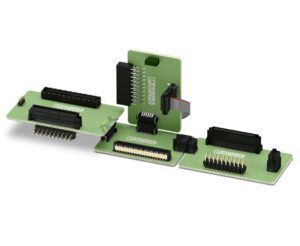
Surface mount technology is slowly making inroads in the connector market. Many smaller form factor connectors, such as FFC and FPC, have already either been converted to SM versions or are only available with SM contacts. Products ranging from 0.025 square post headers to subminiature-D connectors are now available in SM configurations. Tiny solder balls attached to a surface-mounted component provide precise quantities of solder on small centerlines, and are beginning to appear on surface-mounted connectors. The FCI MEG® and GIG Array® mezzanine connectors utilize ball grid array (BGA) termination, as does the Amphenol TCS NexLev® connector family.

In some cases, mechanical hold-down features have been added to assist in properly locating the connector to the SM pads, as well as mechanically attaching the connector to the board.

FCI recently announced the availability of their AirMax VS® backplane connector with BGA attachment. They also offer PCI Express edge connectors in through-hole, press-fit, and surface-mount versions.

Wider adoption of surface-mounted backplane connectors will likely advance as concerns about long-term reliability and compatibility with existing manufacturing processes are addressed. Amphenol TCS presented a white paper at DesignCon 2006 that outlined a number of potential solutions to coplanarity, solder fatigue, and connector registration concerns. The need to design higher performance circuits, together with proven alternatives to the plated through-hole, may ultimately drive the transition to surface-mounted connectors.
Request a copy of this paper.

Bishop & Associates Comments:

  • Change comes slowly to established and proven electronic product design and manufacturing processes. Acceptance of alternatives takes years of testing and evaluation to demonstrate technical advantages, cost effectiveness, as well as long-term reliability.

  • Transitioning from through-hole wave soldering to press-fit connector termination took many years of extensive testing and verification of manufacturing processes.

  • The plated through-hole has been identified as a major source of high-speed signal distortion. Connector suppliers have implemented a number of changes in their connectors to minimize the impact of the connector launch on performance, but we may be nearing the limit of press-fit terminated connector technology.

  • Well-justified concerns exist regarding the use of larger surface-mounted connectors. Solder joint fatigue, connector registration, and coplanarity issues must be resolved, and solutions fully documented before the industry adopts surface-mount connectors as mainstream technology. The potential electrical advantages offered by surface-mount connectors are a lively topic of debate among engineers.

  • New surface-mounted connectors continue to appear on the market in larger form factors, allowing the industry to gain experience and confidence in utilizing this new technology.


Robert Hult
Director of Product Technology, Bishop & Associates, Inc.

Robert Hult has been in the connector industry for over 36 years. Hult began his career as a sales engineer for Amphenol. He joined AMP in 1972 and served in several management positions through 1996. In 1997, Hult joined Foxconn as group marketing manager for Intel, Chandler, Arizona, U.S.A. Prior to joining Bishop & Associates, Hult was the regional application engineering manager for Tyco Electronics.

Hult graduated in 1968 from Bradley University with a Bachelor of Science degree in electronics technology and a minor in business.


  home_top_buttons.gif
  con_sub_med_.gif

Bishop & Associates, Inc. © 2007