154_h_button.gif
 
152_archive_button.gif


The Development of Application Specific Connectors

By Dr.-Ing. Wolfgang Jacobi, CEO, ODU / Otto Dunkel GmbH

Components like capacitors, resistors, connectors, and PCB-boards can generally be divided into three categories: standard; design-in; and application specific products. Let’s take a look at the differences in these categories and how they relate to connectors.

1. Standard Products
Standardized products are normally offered by numerous suppliers. Usually this means that they are interchangeable. Examples are the RJ45, USB connector, or IDC connectors according by DIN 41651.


2. Design-in Connectors
In this case, various suppliers offer different solutions for one and the same connection. When the customer has chosen (or “designed-in”) a supplier, that supplier is quite often the sole supplier for that customer. Substitution of this product with a competitor’s connector is usually not possible.


3. Application Specific Connectors
In this case there is normally one customer and one supplier. Generally, there is no connector available on the market which meets the specific requirements of the customer. Costs for design, prototypes, laboratory tests, tooling, and production set-up occur.


Reasons for the use and development of application specific connectors are usually:

  • Function – connectors which satisfy the requirements cannot be found in the marketplace.

  • Design – connectors in the medical industry are very often specialized, therefore the design is specific to the application. This also applies to interface connectors, i.e. connectors that are visible or actually handled by the user.

  • Cost – with expectations of large quantities, application specific connectors can lead to significant cost savings.

  • Exclusivity – the manufacturer will consider this important because they want to prevent third parties from copying accessories.

The choice of product categories is also a strategic choice. Manufacturers can only stay successful in the area of standard products if they are cost leaders. On the other hand, small and mid-sized manufacturers can be very successful with application specific developments.

Application Specific Connectors

Interface Connectors for Cellular-Phones
The picture below shows a popular cellular phone from Sony Ericsson. The interface connector allows the user to charge the battery using a two-way charger-plug and connect a headset using the four-way audio-plug. The interface connector also allows the user to connect the cellular phone to a hands-free speaking system in the car.

The picture (below, left) shows the insulation body, with and without contacts, of the same cell phone. There are a total of 11 (7+4=11) pressure contacts connected to the board of the cellular-phone. The injection mold shown in the picture (below) uses a total of four hot channels. Over 30 million insulation bodies have been molded with this tool to date.


The stamping tool (below) demonstrates how the contact is made, step-by-step, in a modular tool. The four- and seven-way contact combs are interleaved with each other in order to reduce material waste.


Due to increased globalization, the choice between automatic or hand-assembly has become more important. Even five years ago, Western connector companies primarily chose automatic assembly for high-volume products such as cellular phones and were still able to produce them cost efficiently in Europe and the U.S.A. This has changed dramatically with the emergence of China in the world market.

An automatic assembly line (below) costs between 250.000-€ and 500.000-€, including automatic packaging and image processing. It takes roughly eight months from conception-to-production of the connector in this scenario. Hand-assembly in China requires 50.000-€ to 100.000-€ for simple hand tools, testing equipment, and turnaround can be as quick as 24 hours or at most, eight weeks. This is a huge advantage with regard to time and costs, especially considering the shortened project runtime and the high risk of project success or project failure.


Push-Pull Connectors for High-Frequency Measurement
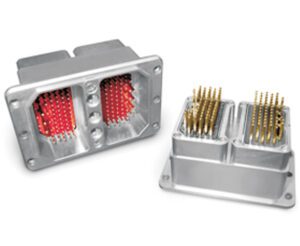
The high-frequency measurement equipment (below), used to test base-stations in the cellular communication infrastructure, required a connector that could be connected quickly and effectively in the smallest of space, while allowing maximum flexibility between the receptacle and equipment board. The next picture shows a turned metal housing from the standard ODU MINI-SNAP series. The insert, i.e. the insulation body, was developed especially for 2x 50W coax contacts and 16x signal contacts. The contacts themselves come from the standard ODU MINI-SNAP series.


Connector for Patient Spool in Magnetic Resonance Imaging
Modern magnetic resonance imaging allows patients, or a specific body part, to be thoroughly analyzed in a short amount of time. The top-of-the-line devices currently use a magnetic field with strength of 3 Tesla. It is therefore preferable and often necessary to use fully non-magnetic connectors.

Medical application specific connectors must be able to handle a large number of connect/disconnects and maintain reliability. Assume a patient's testing time of 15 minutes creates four mating cycles per hour or 60 cycles per day - that means that modern MRI machines will require over 100,000 mating cycles in 10 years!


These MRI machines use ODU MAC modules and contacts where the basic connector design has not been modified other than by the use of non-magnetic materials and the development of an application specific housing. The following pictures show the plastic housing using two component injection moldings with TPE for the grip surfaces.

Household Appliances
Unlike what most people imagine, household equipment often have extreme requirements for their connection system. The pot shown is used two, three, and even four times a day. After each use, the pot is usually placed in the dishwasher and is exposed to mechanical, thermal, and corrosive forces.

Due to the expected lifetime of 10 years, a unique technical connector solution was chosen: the contact pins are turned and plated with gold (Tribor) and the contact sockets are stamped and silver-plated. This has proven to be a winning combination for this harsh environment.    


Prototype Manufacturing
Connectors usually consist of contacts, insulation bodies, and housings. In some cases the plastic insulator and plastic housing are combined together.

While considering the manufacturing of prototypes, we will first look at the contacts. Turned contacts are relatively unproblematic and can be produced with minimal costs (e.g. set-up times of maximum eight hours).

It is more difficult when the contacts are to be made out of sheet metal before the stamping tool is available. In this case the following methods can be applied:

  • Simple stamping tools

  • Wire-cutting and bending

  • Etching and bending

Wire-Cutting
During wire-cutting, sheets of the designated sheet metal are stacked on top of each other using brass plates at the top and bottom as stabilization.

  • The stack height is generally not more than 25mm.

  • The stack is welded together on the sides.

  • Starting holes are drilled and then the contour (programmed based on DXF File from CAD station) is cut.

  • A small guts degree needs to be removed from the individual pieces.

Etching with the Lithography Principle

  • First a covering film is created and the sheet metal pieces (e.g. 200 x 300mm) are covered with a photographic lacquer.

  • The films are pressed against the sheet metal using vacuum and light is applied.

  • During the photochemical treatment, the film protects specific areas of the sheet metal from etching.

  • Finally, the remaining lacquer is washed off.


The manufacturing of insulation bodies and plastic housings for prototypes is generally done by stereolithography.

A bath of resin is irradiated layer-for-layer by a laser. Wherever the laser touches the resin, the resin hardens. In the first step, the STL part is created (positive). Next, a silicone mold (negative) is made using the STL part. In the last step, a polyurethane casting is made in the silicon mold. These steps can be performed by the connector manufacturer or by a special supplier within one to two days.

Here it should be mentioned that the STL-process is not suitable for extremely small geometrics such as insulator wall thicknesses with a tenth of a millimeter between the contacts.


The Three Steps of Stereolithography

The Development Order
A major problem when dealing with custom developments is that neither party wants to assume unnecessary risks:

  • The connector supplier shies away from the financial outlay for design, development, and prototypes if the possibility of not getting a substantial, ongoing order is good.

  • The customer is afraid of the risks of paying for development or tooling without being certain that the results are what they are looking for.

In many cases the development order can solve this problem.

The connector supplier considers whether or not they can, or want to, manufacture the required parts. A quote is submitted for the design, development, prototypes with laboratory testing, and a detailed analysis of the requirements. These steps are quite often necessary before a binding quote can be given for the parts.

At ODU it is generally a rule that the customer is free after the development order, meaning that he can take the results of the development order and ask for a quote for the parts from other suppliers.

Cooperation During the Development of Custom Connectors
The development of a product that is not yet available on the market puts special requirements on both the connector supplier and the customer.

As a rule, the connector supplier must not only demonstrate a high level of technical competence, but also be flexible and able to act unconventionally to problems that may come. It is a necessity that the company is trustworthy and calculable as a supplier. The sales team must be able to sell this trustfulness and competence, which is much more difficult than selling catalog products or products which are already available on the market.

The supplier of application specific connectors is usually the sole supplier. With that comes a high level of responsibility, because without this sole supplier, the customer cannot deliver its product. On the other hand, being the sole supplier gives the connector manufacturer a certain position of strength which allows for certain price considerations.

At ODU we have come up with the 7:1 Rule. This means that we are only interested in a custom development if over the lifetime of the product, the sales can potentially generate at least seven times as much as the outlay for development and tooling. Here it must be noted that it does not matter if the tooling is paid for or not. ODU is not a tool shop, but rather a connector manufacturer and only interested on developments which fulfill the 7:1 Rule. This precondition is critical in prioritizing the client capacity in design, engineering, and the tool shop, and to ensure that the departments are not blocked by uninteresting projects.

When considering the customer, this situation is a mirror image:
They are dependent upon the supplier and if the order is placed, the supplier has a position of relative strength.

Purchasing has to adapt:

Purchasing can make strategic decisions, to decide which supplier is trustworthy and reliable over the long-term. Then, they have to handover competences to their colleague in design and development as soon as the development order has been placed and must generally limit their activities to logistics. Significant design, investment, and qualification costs can arise and they may be confronted with the question of whether or not to look for a second distributor for the custom connector. Here there are no general answers, but the trend is generally picking one sole supplier and intensely monitoring them.

In summary, one can say that custom connectors can only be developed in a partnership. The supplier assumes a technical and financial risk while the customer has a commercial and temporal risk.

Worldwide connector sales are over $35 billion annually (2004). A large position of this business is generated out of application specific developments. An exact quantification is hardly possible.

According to our observations the percentage of custom connectors is increasing, especially in the telecommunication, automotive, and medical field. This rate has been continuing f


  home_top_buttons.gif
  con_sub_med_.gif

Bishop & Associates, Inc. © 2010