154_h_button.gif
 
152_archive_button.gif


Who’s Got Your Back?
Choose a connector that can stand up to the highest demands

By Lynda Nolen, Bishop & Associates Inc.

History is filled with instances in which chemical and biological agents were used to injure or kill people. Early writings tell of not only individuals who were assassinated with the use of a chemical or biological agent, but also how entire civilizations, towns, and armies were incapacitated or destroyed. Although numerous attempts were made to prohibit the use of chemical or biological agents in warfare, including the Geneva Protocol of 1925, with no means to control their development, most of these attempts failed. Instead, over the last century, as civilization has advanced, so has the development of biological, chemical, and now nuclear and radioactive agents. These agents can be used to sustain a civilization, as in the development of nuclear power plants, refineries, and immunizations, or as a way to harm or destroy a civilization—as in the development of weapons of mass destruction.  Handled properly and in a regulated environment, these agents can be of extreme benefit to mankind, but unregulated and placed in the hands of the wrong people, the damage can be widespread and devastating.

As CBNR (chemical, biological, nuclear, and radioactive) agents have proliferated, companies manufacturing equipment focused on sensing and detecting a breech or attack, as well as neutralizing and decontaminating an area and personnel have also developed. These global companies use a variety of methods to detect or sense the presence of CBNR agents, as well as neutralize or contain them until a course of action can be determined. The equipment can be large enough to protect an entire area or region, or small and portable enough to protect an individual or small group.

The most prevalent method of detection is linked to the use of some type of sensor. The key to these sensors is their ability to discern a range of agents, and to classify and identify the type of agent. For chemical agents, a popular form of sensing is linked to the use of ion mobility spectrometry. Similar to mass spectrometry, ion mobility spectrometry senses the presence or absence of a chemical by colliding the ions of the chemical with neutral gas molecules and passing them through a collector that generates an electrical current to be measured. This method allows for quick, accurate, and continual monitoring of airborne chemicals. Another popular form of sensing uses Fourier Transform Infrared Spectroscopy (FTIR). Similar to the way an individual can be identified by their fingerprints, computerized FTIR equipment uses the infrared absorption spectrum created by the chemical to identify it. Used in industrial areas for continual monitoring, ion mobility spectrometry and FTIR are also used extensively in Automatic Chemical Agent Detector Alarm (ACADA) and Mobile Chemical Agent Detector (MCAD) units used by the military. Much of this use stems from the units’ ability to be remotely deployed, vehicle mounted, or in the case of ACADA, carried by a soldier.

As with chemical agents, the key to detecting and stopping biological agents is the ability to sense them quickly. Unfortunately, unlike chemical agents, which generally initiate a quick reaction, biological agents usually have an incubation period. During this period, symptoms may not appear, but the agent is still capable of being transferred. Unlike chemical agents, the effectiveness of a system to sense biological agents is also very hard, if not impossible, to completely test. One other characteristic of biological agents is the medium in which they can be delivered. Biological agents can be dispersed in a liquid, solid, or gas state, making the use of one type of sensor very difficult. Presently, most systems are designed to identify bio-agents in the air. These include handheld, portable units, as well as large, long-range units mounted on helicopters, that are designed to span an area of approximately 50 kilometers. These units, unlike some of the chemical sensing units discussed above, do not necessarily identify the particular biological agent, but rather look for the typical signs associated with a line source agent released by aerosol. The key here is to not necessarily identify which bio-agent it is, but to sense the release of one, giving personnel sufficient time to seek protective gear.

It has been estimated by the U.S. Government Accounting System that between 2007 and 2017, the Domestic Nuclear Detection Office will spend approximately $3.1 billion on equipment designed to detect radiation at major U.S. ports. This amount does not include equipment installed at major international ports, including the February 2010 completion of radiation detection systems at Colon Container Terminal and the Port of Cristobal in Panama, and the Port of Manzanillo, Mexico. This also does not include maintaining and protecting the 436 existing nuclear power plants in 30 countries that are currently operational, or the 55 reactors currently under construction. Preventing terrorists from transporting radioactive materials across borders, as well as safeguarding current nuclear power plants from terrorist attacks, is a huge proposition.

Many have claimed that security at nuclear power plants is currently insufficient, just as many have claimed that there are countries engaged in non-civilian nuclear activities. How do you increase security as well as monitor the activity of materials necessary to create a nuclear agent? In the case of both existing and future nuclear power plants, continual inspection and detection are still the best answer.

Currently detection at most sea ports and major land border crossings is performed using radiation portal monitors in conjunction with handheld radioisotope identifiers. Unfortunately, this method of detection has been shown to produce a significant number of false positives, which then require individual secondary inspection, which creates delays and employs costly manpower. To overcome these shortfalls, in 2004 work began on a new radiation detection system called advanced spectroscopic portals (ASPs). Designed to replace existing radiation portal monitors, these ASPs use a suite of radiation sensors that use spectroscopy to detect and identify the radioactive source. Comprised of a variety of sensor cameras, an environmental control system, portal control system, UPS, radiation sensor panels, break beams, and an external annunciator, the first ASPs are currently installed and undergoing extensive testing. Other types of radiation detectors that use spectroscopy include handheld units for both ground and aerial vehicles.

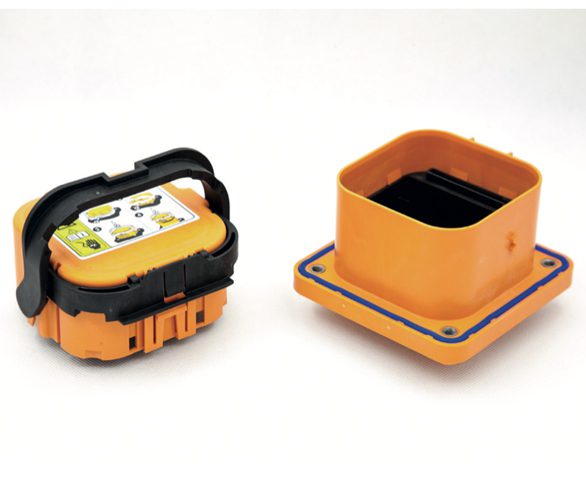
Although the types of connectors used in CBRN equipment vary greatly, many of the connectors are standard military circular, rectangular, and PCB types. In applications where interconnects are exposed to extremely harsh conditions, such as extended temperatures or in areas of potentially high exposure to nuclear or radioactive agents, special precautions must be taken.

Murtaza Fidaali, business development manager at ITT Interconnect, said, “Additional features, such as sealing, will vary depending on what the connectors are used for and if they must perform critical functions during a failure. For instance, control rod drive cables and reactor vent valve cables must function if there is a nuclear plant failure. In that case, the whole interior of the plant is sprayed with a boron solution under high pressure, with an elevated temperature. You must show that the cables and connectors will function for 40 years, and then will work for some number of days. The ability to function for extended periods of time, such as 40 years (the planned life expectancy of a nuclear power plant), also precludes the use of plastic shells. Instead, shells used on connector applications involving potential exposure to nuclear or radioactive materials are generally made from nuclear grade stainless-steel.”

According to Fidaali, in addition to special shells, connectors used for in-containment nuclear applications also require inserts, gaskets, grommets, bushing, and o-rings made of special high-temperature, high-radiation-resistant materials such as Viton® or flouro-silcone, that will not degrade or become brittle over periods of exposure. Also, "because workers are limited in the amount of radiation exposure they can receive, ITT Interconnect products, like breakaway and bayonet-style connectors, are desirable, because they incorporate ease-of-use with decreased installation and de-installation time.”

Similar to connectors used for in-containment applications, connectors and assemblies used in other CBNR applications, such as monitoring or sensing equipment, must also meet special requirements, one of the most important of which is sealing. Proper sealing to IP68/69K, whether mated or unmated, not only protects the equipment from degradation due to ingress of moisture or dirt, but also allows the connectors and assemblies to be thoroughly cleaned (decontaminated) in case of exposure.

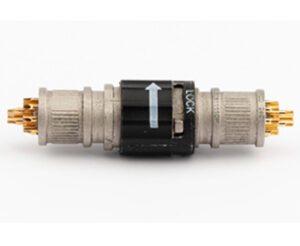
In addition to IP68/69K sealing, connectors used in handheld or portable CBNR sensing or detecting units must also be easy to use and offer complete electromagnetic shielding. Mating must be quick and secure, whether mated in total darkness or while wearing heavy protective gear. In the case of detection units carried by military personnel or first responders, the connectors must also be lightweight, yet rugged enough to operate effectively under the most extreme environmental conditions, including high vibration and shock. Due to the often sporadic use of this type of equipment, connectors must also offer exceptional life expectancy and mating cycles.

Connectors in CBRN Applications

Connector types used in equipment designed for CBRN detection, monitoring, and analysis come from all product types. Including: 

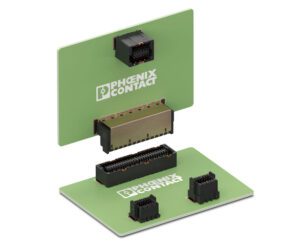
▪  PCB Connectors
       PCIe
       Stacking connectors
       PCB receptacles and headers
       FFC/FPC

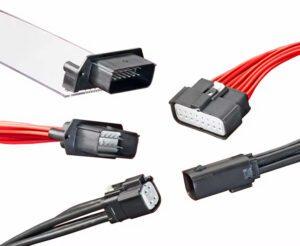
▪  I/O Rectangular Connectors
       Ruggedized USB connectors
       InfiniBand, Gigabit Ethernet
       D-subminiatures

▪  RF connectors
       Miniature and ultra-miniature board-to-board
       connectors
       Subminiature—Standard and reverse polarity SMA
       Medium—Standard and reverse polarity Type N
       and TNC

▪  Circular Connectors
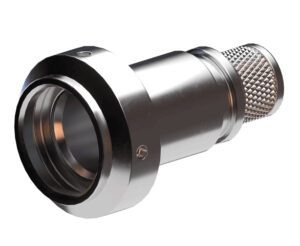
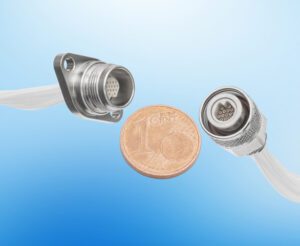
       Ruggedized metal shell push/pull connectors
       Stainless-steel self-latching connectors
       Standard mil-spec approved

       Application specific

▪  Fiber Optic Connectors
       Single-mode
       Multi-mode
       EMI adaptors

▪  Power Connectors

▪  Electrical Penetrators

Companies Involved in CBRN Activities
There are numerous companies throughout the world that participate in CBRN detection, monitoring, analysis, and decontamination. A sampling of these companies is listed below:

Bertin Technologies SA—France

Bertin Technologies SA is a European leader in the development of equipment for detecting and identifying biological and chemical threats for defense and homeland security purposes. Products include ruggedized biological air samplers, field-compact air samplers used primarily by first responders, early warning stand-off gas cloud chemical detectors dedicated to real time surveillance of critical areas, and field bio-identifiers used for the identification of biological warfare agents within 10 minutes of exposure.

Bruker Daltonics—United States

Supplying systems for substance detection and pathogen detection in security, defense, and anti-terrorism, Bruker Daltronics’ field-hardened systems make use of advanced mass and ion mobility spectrometry, as well as Fourier Transform Infrared Spectroscopy technologies.

Bubble Technology—Canada

Combining scientific, engineering, and manufacturing expertise, Bubble Technology is a world-renowned leader in the field of radiation detection. Their products include radiation detectors and dosimeters, radiation spectrometers, and explosive detectors.

Environics Oy—Finland

Offering over 20 years experience in the CBNR field, Environics Oy focuses on security solutions from early warning to consequence management. Products include CBRN cleaning and decontamination products, chemical detection and analysis equipment, and biological detection systems, including buildings, airports, underground, and industrial facilities.

General Dynamics Armament and Technical Products (GDATP)—United States

GDATP offers over 30 years experience in the development, production, and support of chemical and biological detection systems. Their products include hand-held and stand-off chemical agent detectors and biological agent warning sensor systems.

Kinetics Ltd.—Israel

Producing systems and components for military platforms, including fighting vehicles, tactical vehicles, mobile and stationary shelters, aircraft, and helicopters, Kinetics Ltd. provides advanced solutions in chemical, biological, radiation, and nuclear protection and detection.

OWR AG—Germany

OWR AG is a leading specialist in the decontamination of personnel, equipment, and vehicles subjected to NBC agents. Products include portable decontamination equipment, universal decontamination systems, and multi-purpose decontamination systems for buildings, equipment, and vehicles. OWR also provides chemical agent detectors, point detection units for biological warfare agents and hazards, and radiation monitoring instruments.

Pimco Sp. Zoo—Poland

Pimco is a respected manufacturer and supplier of equipment for detecting weapons of mass destruction, including the detection of chemical agents, radiological threats, and nuclear weapon detonations. Their family of products includes chemical, nuclear, and radiological blast detector systems and portable chemical agent detectors.

Proengin—France

One of the only companies using flame spectrophotometry to detect biological and chemical warfare agents, Proengin manufactures detection systems for chemical warfare agents and toxic industrial chemicals, biological detectors, and maintenance equipment and accessories.

Smiths Detection—United Kingdom

A global leader in CBNR threat detection and screening equipment for public service and military personnel, Smiths Detection uses multiple technologies to quickly identify a wide range of threats. Their range of products includes biological identifiers and classifiers, vapor, solid, and liquid chemical detection systems, and radioisotope detection and identification equipment.

There is no doubt that the number of products and companies involved in the sensing, detection, and analysis of CBNR agents will continue to grow over the next decade. This, combined with the astonishing growth in nuclear power plants, will offer extreme harsh environment connector manufacturers numerous new opportunities. According to ITT Interconnect’s Fidaali, another area where “we may see significant business opportunities in the near future is in the replacement cables and connectors. Many of the nuclear power plants, especially in North America, are getting older and will require replacement of existing components.”

Whether it involves providing more sophisticated sensing, detection, and analyzing equipment, or providing new or replacement connectors and assemblies to nuclear power plants, the world of CBNR is highly dependent on the connector manufacturer. Their ability to supply high quality, ruggedized connectors and assemblies to this growing market allows even the most pessimistic of us to feel more secure.


Lynda Nolen
Product Specialist, Bishop & Associates Inc.

Lynda Nolen has been in the interconnect industry for more than 30 years. She has worked in sales, sales management, marketing, and product management for such companies as TRW Electronics Components Group, Sunbelt Components, Cinch Connectors, Arrow Electronics, PEI Genesis, and Delphi Interconnect. Nolen has extensive experience in competitive cross-referencing, drawing, web and catalog review, new product introduction programs, harness and connector assembly programs, account management, and customer service programs. Lynda received her bachelor of arts degree from Roger Williams University in Rhode Island, and has completed various electrical engineering courses.


  home_top_buttons.gif
  con_sub_med_.gif

Bishop & Associates, Inc. © 2010