RAST, the Old/New Appliance Standard
By Lynda Nolen, Bishop & Associates Inc

The global market for connectors used in consumer applications is expected to top $2.8 billion by 2013. A key segment of the consumer market is the household appliance, or “white goods,” industry. Encompassing a variety of items we use daily, the white goods industry includes washing machines and dryers, refrigerators, microwaves, freezers, dishwashers, trash compactors, and stoves, all generally referred to as major appliances. It also includes small appliances, such as coffeemakers, mixers, and toasters. These products are usually taken for granted until they stop working, but consumers are taking a greater interest in the category, due to improved designs that offer new convenience and safety features, and consume less energy. Many of these improvements have been spurred by the increased use of electronics in appliances over the last 10 years.

For instance, some new refrigerators do more than just keep your food cold; they feature T.V. screens, radio, and Internet access. You can look up your favorite recipe online, and charge your cell phone, MP3 player, or DVD/CD player while you cook. While that model may not be in everyone’s home, other cutting-edge features are becoming commonplace. Today, dishwashers rely less on chemicals for cleaning, and instead count on higher water temperature to sanitize and clean. Dishwashers also use far less water and energy than units produced even 10 years ago, and many, especially in Europe, incorporate heat-recovery systems that use the steam generated by the machine to heat incoming rinse water. Another innovation is energy management, which enables appliances to receive signals from the local utility company, and using an internal program, regulates when operations such as frost modes on a refrigerator are performed, which reduces energy consumption during more expensive peak hours.

Two key factors in the increased use of electronics in appliances are standardization and modularization. In the realm of standardization, the most influential connector system is the RAST system. These connectors were developed more than two decades ago in Europe as a way to standardize components, assure intermateability among manufacturers, and reduce plugging errors. The RAST systems, like the appliance industry, have undergone a transformation in the last decade.

RAST, says Lee Thomas, industry marketing manager, home appliances at Molex, “is the acronym for Raster Anschluss Steck Tecknik, roughly translated from German as “pitch connection plug technology.” Controlled by the ZVEI (Zentralverbank Elektrotechnik–und Elektronikindustrie e.V, German Electrical and Electronic Manufacturers’ Association) committee, RAST connectors form the connection system for the multiple sensor, switch, actuator, and motor drive wires that connect to the control board. Initially developed using a crimp-style contact—in which the wire was stripped, crimped, and snapped into a plastic housing—many of today’s RAST system components now incorporate an insulation displacement termination (IDT) contact that allows termination of the wire without stripping or crimping. Because the contacts are pre-assembled in the housing, there are fewer components to worry about, and less chance of wires being inadvertently snapped into the wrong position. These advantages broaden the RAST system’s appeal and potential.

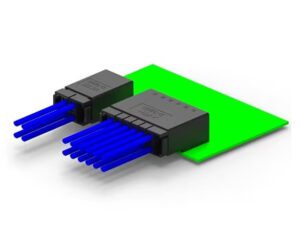
Developed around two contact pitch configurations, 2.50mm (.098”) and 5mm (.200”), RAST connectors are available in a variety of versions, with multiple keying, coding, and locking options. “The Molex RAST line-up includes RAST 5 IDT and crimp for indirect mating in either 10 amp or 16 amp versions. RAST 2.5 for direct and indirect mating, and RAST Power for direct and indirect mating in both 6 amp and 10 amp versions,” said Thomas. “Optional polarizing ribs, color coding, side latches, and pip locks are offered throughout the range, in addition to open or slotted sidewalls on the RAST 2.5 and RAST Power connectors.” To complement their range of RAST IDT and crimp connectors, Molex also offers a full range of mating headers in vertical and right-angle versions.

In addition to thru-hole PCB-mount products, many European manufacturers of RAST connectors also offer surface mount versions. STOCKO Contact, the first company in Europe to offer surface-mount RAST connectors, offers product made of DSM Engineering Plastic’s high-performance Stanyl® Fortii™. Use of this high-performance material allows connectors to be assembled to the board by lead-free reflow soldering, reducing assembly time, and thus reducing cost.

Modularization, the second key factor that has influenced electronics features in appliances, is also supported extensively through the RAST system. As more and more features are added to an appliance, the number of connectors increases, as each of these features must be connected to the control panel. Rather than using individual connectors and harnesses, RAST provides the ability to gang up connections, reducing the number of harnesses. Using both color-coded and uniquely keyed and polarized connectors, the RAST system reduces assembly time and the chance of mis-wiring, while reducing the number of components a manufacturer has to keep in inventory.

Reducing the number of components that have to be inventoried is especially advantageous in North America, when a consumer or business owner requires repair on a domestically manufactured product. Due to a lack of standardization, service centers that support repairs are often required to carry a much wider breadth of inventory to satisfy a large number of manufacturers. Lack of standardization is even more noticeable to the North American consumer when the required repair is on an appliance assembled in China or the Asia Pacific region. Because of the broad number of manufacturers who supply components to the white goods industry, it is not uncommon for a consumer to wait weeks while a part is ordered and shipped from overseas.

Although the RAST connector system is still primarily in use in Europe, many signs indicate that as the benefits of the system become more apparent, other countries will adopt it as well. According to Thomas, “the new global interest in the RAST system is based both on process improvements and cost-savings. Automated IDT systems not only add speed to the wire harness assembly process, but also provide testing to lower the applied costs in the manufacturing process. As IDT typically uses an automated process, harness failures are significantly lowered compared to manually-built harnesses, which are normally crimp-and-poke-type systems. A harness failure can be extremely costly for a manufacturer when you consider the rework costs to replace a failed connector on a harness that is already loaded into an appliance.”

Another reason the RAST systems have not become as prevalent in other countries, primarily, Asia and China, is that unlike in other industries, in the white goods industry, geographic presence plays a much larger role in shaping product types and preferences. “In North America, it is not uncommon to have a large washer and dryer. The average American home is designed with a separate area just for doing your laundry. But go to China, a country with the greatest population in the world, and space is at such a premium that most Chinese families live in small apartments. In China, stacking or compact units are more prevalent,” says Brian Krause, vice president of marketing and communications for Molex. “In Asia, the acceptance of RAST by OEMs is somewhat limited to global OEMs selling into the market. At present, the relatively inexpensive labor in the region, coupled with the low capital expenditure, does not make the transition from the manual crimp-and-poke-type systems to automated RAST systems cost effective. In the future, Asian OEMs may adopt a RAST crimp/RAST IDT hybrid concept in order for them to adopt new technologies and better serve their growing indigenous market,” said Thomas.

Serving both their indigenous market and the international market is exactly what China-based Leoco is doing. One of the few Chinese connector manufacturers to offer RAST connectors, Leoco only offers the crimp RAST 5 wire-to-board connector in two to12 positions at this time, but Claire Chang, sales director for Leoco USA, said the 2.5 RAST and the IDC RAST are both currently under development.” Chang also acknowledges that although their primary customers right now are European, they do work extensively with Chinese-based contract manufacturers who are buying and assembling parts for European customers. Notably, rather than being used in a major appliance, such as a washer, dryer, or refrigerator, Leoco’s RAST products are currently used in smaller appliances, designed for both commercial and consumer use.

The ability to satisfy local safety standards is also very important when dealing with manufactured equipment, especially equipment such as appliances that are geared primarily towards consumer use. In North America, this means being able to satisfy UL and CSA standards, in particular, UL94V-0. UL94V-0 evaluates the combustion of a particular item when brought in contact with a direct flame. In order to satisfy UL94V-0 requirements, a flame must be out in 10 seconds or less, no glow must be visible beyond 30 seconds, and no burning material can fall from the flame.

In Europe, this means not only being able to satisfy TUV standards, but also IEC 60335-1, fourth edition. IEC 60335-1, fourth edition, often referred to as the Glow-Wire European safety standard, is much more stringent than UL94V-0 requirements, in that it covers both direct flame and indirect flames. “This certification is required on all home appliances sold in Europe. The Glow-Wire standard acts as protection against fire for unattended electrical household appliances. The test is designed to identify plastic materials that could ignite when wires are overloaded. To pass the test, a connector is submitted to a glow wire at 750ºC for 30 seconds. There can be no ignition, or any flames must self-extinguish within two seconds. Molex RAST connectors meet the strict Glow-Wire European safety standard, as well as U.S. safety standards,” said Thomas. Chang also acknowledges the importance of satisfying the European Glow-Wire safety standard. “Yes, Leoco’s RAST products definitely all meet the Glow-Wire European Safety standard, in addition to being UL-recognized, CSA-certified, and TUV-licensed,” said Chang.

One additional driving force behind the increased use of RAST worldwide is the number of component manufacturers and subassembly manufacturers now incorporating built-in RAST headers and terminals in their products. Some examples include: 

  • Cherry D4 miniature switches

  • EPCOS temperature measurement probe assemblies

  • Danfoss electronic temperature control units

  • Honeywell FS300-100 combi-sensor for boiler systems

  • Bitron pressure switches

  • ETA door lock relay type 6110

  • Micro-Epsilon integrated load and unbalance sensors

  • Dungs® automatic gas burner controls

  • Tytronic re-igniter with valve control units

  • Clark Solutions liquid vortex flow sensors

  • Huba Control pressure transmitters


Used in a wide variety of applications, RAST connectors provide a valuable connection to:

• Water temperature sensors

• Load balance sensors    

• Water level sensors 

• Air temperature sensors  

• Spin speed sensors   

• Pressure switches and sensors   

• Heating oil temperature sensors

• Switches indicating water soil level

• Door open and close sensors

• Water control switches

• Drain pump switches

• Switches and valves on gas burner controller

With all of the apparent advantages the RAST system has to offer, it is not surprising, as Thomas points out, that “today, major appliance OEMs and harness manufacturers are designing RAST connector systems into many next-generation home appliances.”


Lynda Nolen
Product Specialist, Bishop & Associates Inc.

Lynda Nolen has been in the interconnect industry for over 30 years. She has worked in sales, sales management, marketing, and product management for such companies as TRW Electronics Components Group, Sunbelt Components, Cinch Connectors, Arrow Electronics, PEI Genesis, and Delphi Interconnect. Nolen has extensive experience in competitive cross-referencing, drawing, web and catalog review, new product introduction programs, harness and connector assembly programs, account management, and customer service programs. Lynda received her Bachelor of Arts degree from Roger Williams University in Rhode Island in 1979, and has completed various electrical engineering courses.


Bishop & Associates, Inc. © 2010